Sobre o projeto

O desafio

Environmental crime is among the most profitable forms of serious and organised criminality, and among the least prosecuted. Waste trafficking, illegal mining, pollution offences, chemical crime and wildlife trafficking cause damage that is diffuse, cumulative and frequently transboundary and that rarely fits the categories of ordinary criminal procedure.
Directive (EU) 2024/1203 on the protection of the environment through criminal law, the Environmental Crime Directive (ECD), was designed to close that gap. It replaces Directives 2008/99/EC and 2009/123/EC, expands the catalogue of environmental offences from nine to twenty categories of criminal offences, introduces qualified offences for conduct causing destruction or widespread and substantial damage to ecosystems, and imposes new obligations on Member States regarding national strategies, statistical data, investigative tools, training and specialisation. Member States were required to transpose the Directive by 21 May 2026.
Contudo, os conceitos operacionais centrais da Diretiva — “danos substanciais”, “conduta suscetível de causar danos” e “quantidades não negligenciáveis” — não são autoexecutórios. Têm de ser aplicados pelos inspetores no terreno, pelos agentes policiais que instruem um processo, pelos magistrados do Ministério Público que decidem deduzir acusação e pelos juízes que avaliam a gravidade. Sem critérios de avaliação partilhados, dados comparáveis e instrumentos comuns, a mesma conduta será tratada como infração administrativa num Estado-Membro e como infração penal qualificada noutro. Tanto o efeito dissuasor como as condições de concorrência equitativas que a Diretiva pretende criar ficam comprometidos.
What ECOFORCE does
ECOFORCE supports the effective and harmonised implementation of the Environmental Crime Directive by bridging the distance between legal requirements and enforcement practice.
The project works along four connected lines:
Evidence
Capacity
Comparative legal and operational research establishing what the Directive’s thresholds mean in practice, how administrative and criminal enforcement interact across Member States, what data systems exist, and which investigative tools and technologies are actually in use.
A joint training programme for the full enforcement chain (environmental inspectors, law enforcement officers, prosecutors and judges) built on that evidence, delivered online and at European events, and designed to complement rather than duplicate existing Europol, Interpol, CEPOL and UNODC resources.
Tools
Legacy
Instrumentos operacionais que respondem a obrigações específicas da Diretiva: um modelo para as estratégias nacionais exigidas pelo artigo 21.º, orientações sobre a classificação das infrações ao abrigo do artigo 3.º, n.os 6 a 8, um conjunto de instrumentos para a comunicação de dados estatísticos exigida pelo artigo 22.º, recursos de investigação em consonância com o artigo 13.º, orientações sobre Observação da Terra e inteligência artificial e um mecanismo de intercâmbio de informação para profissionais.
A public repository of results, a replication roadmap for national authorities and European networks, and the transfer of the project’s outputs to EnviCrimeNet for maintenance beyond the project’s lifetime.
Objectives
- Translate the Directive’s key legal thresholds into operational, testable assessment criteria that inspectors, investigators, prosecutors and judges can apply consistently.
- Design a methodological framework for the collection of comparable environmental crime statistics, in line with Article 22 ECD.
- Map existing enforcement tools, national strategies and emerging technologies, and identify the gaps that matter operationally.
- Clarify the interface between administrative and criminal enforcement across Member States, and the coordination mechanisms that make it work.
- Strengthen the operational, investigative and judicial capacity of practitioners across the enforcement chain.
- Disponibilizar orientações e instrumentos práticos, adaptáveis e multilingues que os Estados-Membros possam utilizar diretamente.
- Facilitate cross-border cooperation and information exchange between enforcement actors.
- Secure the uptake and durability of results through integration into European networks and institutional frameworks.
Como trabalhamos
Practitioner co-creation
Two advisory bodies
Inspectors, law enforcement officers, prosecutors and judges work alongside legal, academic and technical experts to design, test and refine every output. This is not consultation after the fact: practitioners shape the tools before they are finalised.
A joint training programme for the full enforcement chain (environmental inspectors, law enforcement officers, prosecutors and judges) built on that evidence, delivered online and at European events, and designed to complement rather than duplicate existing Europol, Interpol, CEPOL and UNODC resources.
Evidence before design
Multilingual and adaptable
Research (WP2) precedes and feeds training (WP3) and tools (WP4). Nothing is produced that is not grounded in a documented operational need.
Core outputs are produced in English and at least two additional EU languages, in digital and print-ready formats, and released in editable versions so that national authorities can adapt them to their own legal and institutional context.
Open by default
Public deliverables are made freely available through the project repository.
Governação
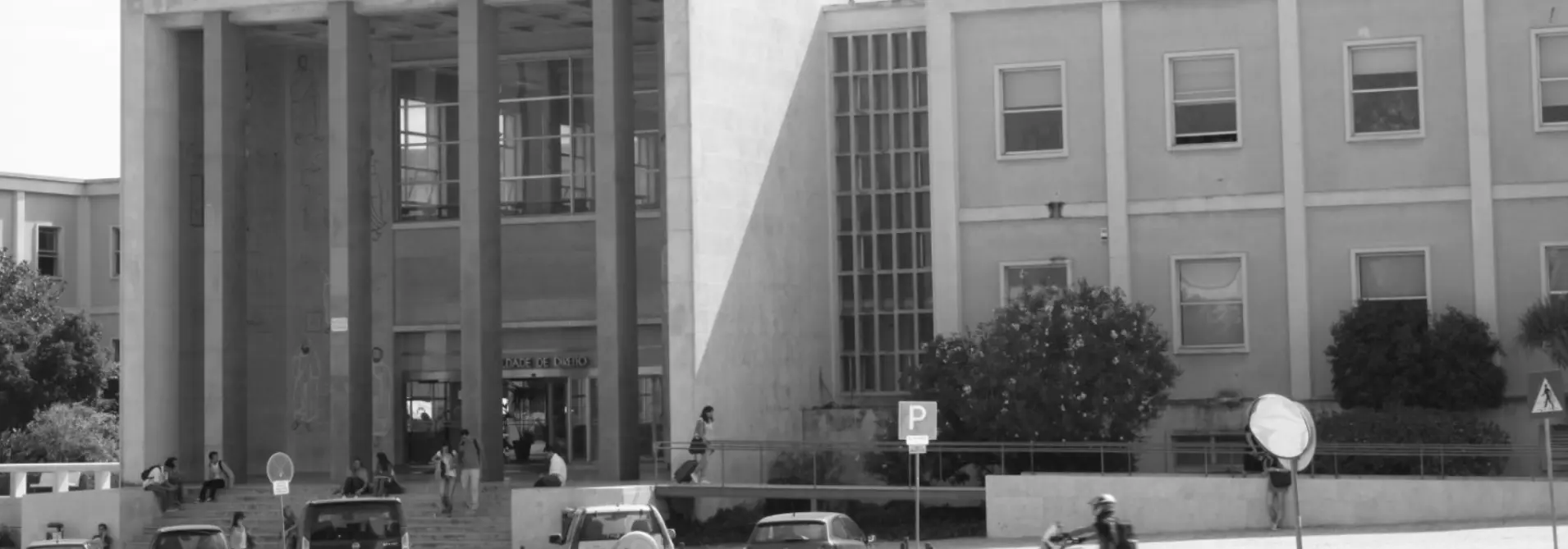
O projeto é coordenado pelo Lisbon Public Law Research Centre — Instituto de Ciências Jurídico-Políticas da Faculdade de Direito da Universidade de Lisboa.
A Project Management Board, chaired by the Coordinator and composed of one representative per beneficiary, with the associated partners attending as observers, provides strategic oversight, validates the quality of deliverables and monitors compliance. It meets monthly online, with in-person meetings at the project’s key moments.
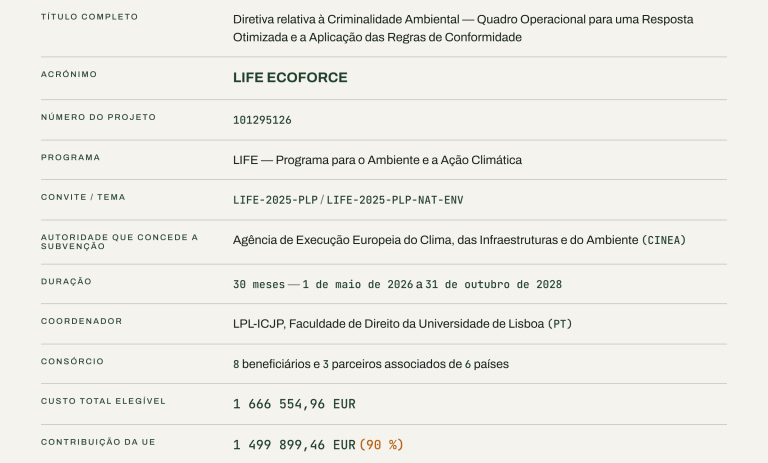
Dados do projeto
Declaração de financiamento da UE
Cofinanciado pela União Europeia ao abrigo do Programa LIFE (Projeto 101295126 — LIFE ECOFORCE). Contudo, os pontos de vista e opiniões expressos são apenas da responsabilidade do(s) autor(es) e não refletem necessariamente os da União Europeia ou da Agência de Execução Europeia do Clima, das Infraestruturas e do Ambiente (CINEA). Nem a União Europeia nem a autoridade que concede a subvenção podem ser responsabilizadas por eles.
Financing: LIFE – Programa para o Ambiente e a Ação Climática | 1 499 899,46 EUR (Ref. 101295126)
Contacto
Entre em contacto
Texto de demonstração para informação sobre financiamento, enquadramento institucional e aviso legal do projeto.