

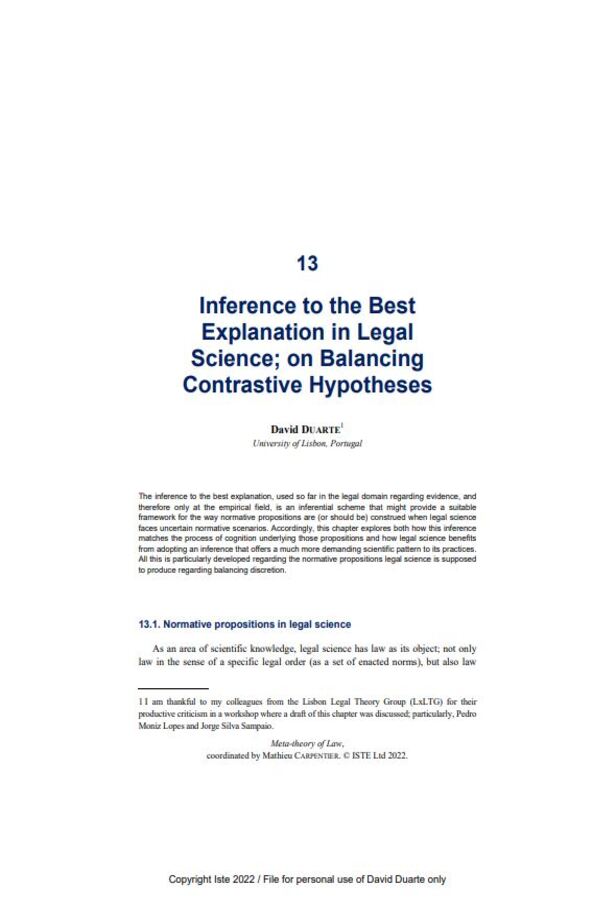
The interference to the best explanation, used so far in the legal domain regarding evidence, and therefore only at the empirical field, is an inferential scheme that might provide a suitable framework for the way normative propositions are (or should be) construed when legal science faces normative scenarios. Accordingly, this chapter explores both how this inference matches the process of cognition underlying those propositions and how legal science benefits from adopting an inference that offers a much more demanding scientific pattern to its practices. All this is particularly developed regarding the normative propositions legal science is supposed to produce regarding balancing discretion.
Home > Publications > Inference to the best explanation in legal science; on balancing contrastive hypotheses
Publication | Book Chapter
Theory and Philosophy of Law
Inference to the best explanation in legal science; on balancing contrastive hypotheses
Book title / Magazine:
Metatheory of Law: Essays on the Methods of Jurisprudence and Legal Science
Metatheory of Law: Essays on the Methods of Jurisprudence and Legal Science
External Author(s):
David Duarte
David Duarte
External Editor(s):
Mathieu Carpentier
Mathieu Carpentier
Within the scope of the Project:
Lisbon Legal Theory
Lisbon Legal Theory
Research Areas:
Theory of Law
Theory of Law
Bibliographic reference:
DUARTE, D. 2022. Inference to the Best Explanation in Legal Science; On Balancing Contrastive Hypotheses. Metatheory of Law: Essays on the Methods of Jurisprudence and Legal Science. Edited by Mathieu Carpentier. New York: Wiley. 329-357.
DUARTE, D. 2022. Inference to the Best Explanation in Legal Science; On Balancing Contrastive Hypotheses. Metatheory of Law: Essays on the Methods of Jurisprudence and Legal Science. Edited by Mathieu Carpentier. New York: Wiley. 329-357.
Research Group(s):
Theory and Philosophy of Law
Theory and Philosophy of Law
978-1789450743
Publishing company: Wiley
Year: 2022